
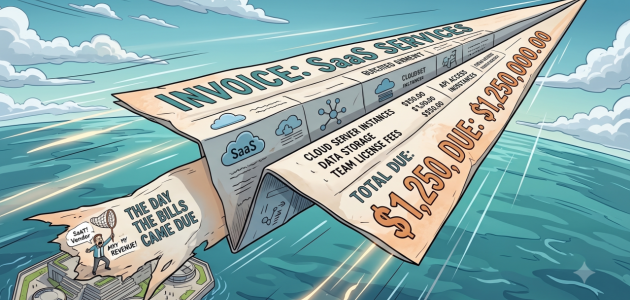
SaaS bills grow faster than inflation while unused licenses and per-user fees add up. AI made custom software far faster and cheaper to build. Renting your tools may now cost more.
I am no fan of long reads. In the age of Twitter (oops, excuse me - X) and TikTok, holding a reader's attention beyond thirty seconds is a luxury very few can afford. I am humble enough not to count myself among them.
Yet, here is my long read. If you are a business owner or in the C-suite, and while reading your P&L you started to wonder why your "L" keeps growing, I might be able to give you some ideas on how to cut it -and perhaps even move a chunk of it over to your Balance Sheet as an IP asset. No promises, just sharing some ideas.
This article is about:
- Building your business on rented land (and why it's getting risky).
- The rising costs of SaaS (inflation is hitting software, hard).
- Subscription graveyards and the silent bleed of unused licenses.
- The "Tax on Success" (how per-user pricing penalizes your headcount growth).
- Integration debt and the sheer chaos of overlapping tools.
- How AI flipped the math (making custom development faster and cheaper than ever).
- Financial engineering (turning monthly OpEx into capital assets and boosting your EBITDA).
- Building a proprietary IP moat to command a premium in M&A valuations.
If any of these topics ring a bell for you, I'd be glad to share my thoughts and hopefully give you some actionable ideas to work on. Again, no promises, but I will certainly try.
Anyone else noticed how several years ago, everyone’s resumes/CVs were swarming with names of obscure little niche tools they knew? A mark of professionalism, in a way. Then these sections got more and more bloated. Now, people just leave the biggest ones like Salesforce or GitHub.
And I think it’s a cultural thing. We’re no longer measuring digital “maturity” with the number of SaaS tools used anymore. On the contrary. Companies are moving toward understanding their “subscription graveyards” need some looking after.
There are very serious reasons, too. Even besides the fact that no one in their right mind wants to pay for a zillion of SaaS platforms and the integrations between them. So after all, I’m not going to be talking about CVs – there’s bigger fish to fry. Even if there’s no mega “exodus” from SaaS, people are already talking about the “Great SaaS Escape” and reevaluating things.
The Rent-vs.-Own Dilemma, or Building on Rented Land
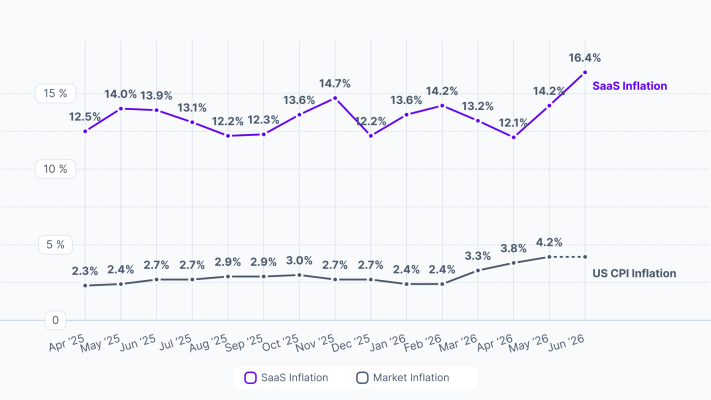
SaaS prices are going up. A report on SaaS inflation index caught the prices increasing at double-digit rates: ~11.4 YoY as of 2025, nearly 5x higher than the 2.7% average inflation rate across G7. Of course, it also peaks during periods of enterprise planning, like it did in Q4 2025 at over 14%. In spring of 2026, we’re seeing 13.2%.
And why not, right? From the SaaS vendor’s perspective, it makes sense. They invested in the future, secured the user bases, and achieved a certain level of lo(ck-in)yalty. Now is time to capitalize. Especially when AI has made purely custom development somewhat cheaper — so it makes sense to implement 2-3 AI-powered features and compete with custom solution developers. And in some cases, raise prices to compensate for the clients lost to AI-powered custom solutions.
To the users, though, this looks like extraction, for all the value provided. Take the same report: SaaS spending per employee was around $7,900 in 2023. By the end of 2025, it was $9,100 already. Multiply that times the amount of users, and that’s where the budgeting meetings stop being relaxed.
The irony is that the initial promise of flexibility was (and is) true. Why build capabilities when you can rent them as a couple of licenses? SaaS totally excel at removing these hurdles. However, if you’ve been successfully using that, you’ve created another type of dependency:
- Your years of data;
- Customized workflows;
- Employee experience;
- Integrations
- now depend on the exact combination of SaaS you have, and the cost of change is now growing, too.
In a way, this is like building and owning a skyscraper on leased land. And the taller it gets, the more epic its hypothetical “breaking free” story will become.

Which makes the “Great SaaS Escape” even more interesting. If only because it’s not just about pricing.
The Silent Bleed: SaaS Sprawl & Waste
How did we end up here?
Hollywood-style flashback, whoosh, we’re in 2015 again. Major development frameworks have been perfected, software teams build apps for everything, but corporate IT and procurement are somewhat wary. Fast forward to 2020, everyone’s working remote, department heads are freaking out, SaaS vendors suggest:
Don't wait for IT. Start a free trial. Invite your team. Upgrade when necessary.
The culture of “tools for everything” starts. The pandemic ebbs, but now every new manager wants to leave their mark on the department they’re leading. Easiest way? Implement favourite tools to facilitate work. Everyone will remember it was “Jeff who showed us the GoWorkoQuicko tool”. Demonstrable efficiency metrics for the C-suite, territory successfully marked.
Interestingly, everyone individually was right.
- Marketing did need analytics.
- HR did need engagement tools.
- Sales did need those CRM extensions.
- The product actually did need roadmapping.
Each department was solving a local problem. The company as a whole was accumulating an ecosystem nobody in particular designed. That’s how decentralized purchasing and PLG (product-led growth) eventually led to severe SaaS sprawl.
The result is a software landscape that exists beyond the visibility of IT management. Statistics say mid-market companies today may operate 100-300 apps at the same time. And I suspect most people working at these companies don’t even suspect that’s the case — they know their department’s toolkit.
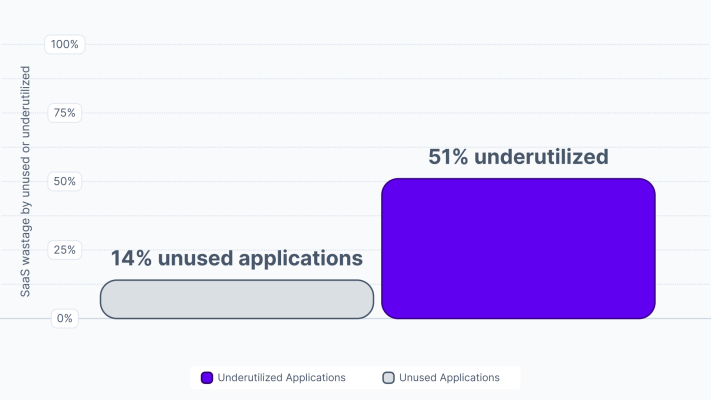
Not all those apps are active. As of Q2 2026, about 65% of SaaS licenses were underused or unused entirely. Nothing strange, just another subscription that survived the project that justified it.
Then, there’s overlapping. The average company will have something like
- 15 duplicative online training apps
- 11 project management tools
- 10 team collaboration apps.
Overlapping, of course, means duplicate functions and duplicate data. Aka chaos. That’s the point where you get platforms for managing all the platforms. That, or somewhere in the corner, some employee is quietly maintaining a spreadsheet to reconcile the entries.
Also, security. Not only is the potential attack surface greater, but unmanaged apps present more vulnerabilities. 65% of employee-expensed SaaS apps carry security risk ratings of "Poor" or "Low" (and only 2% are rated as "Excellent").
None of this is fatal. Companies can clean up unused licenses, consolidate duplicate tools, and tighten security. The bigger problem is what remains after the cleanup: the software they can't get rid of.
The Success Tax & Integration Debt
Suppose you've done everything right.
You audited your subscriptions. Removed duplicate tools. Deleted dormant accounts. Consolidated vendors.
Congratulations, you're still not done.
First of all, per-user seat models penalize headcount growth. More employees means more users and more licenses to purchase. To be able to keep the predictable rhythm where growth means lower cost per unit, you have to actually own the software you use. This is the most obvious “success tax” moment.
Another aspect is the integration debt. Dozens of point solutions stitched together translate into fragile data pipelines. Meanwhile, building a single robust custom API integration costs $20k–$60k with annual maintenance demands of $5k–$12k.
And integrations proliferate, too. Basic graph theory says that, assuming every tool needs to communicate with every other tool, the amount of connections will be
n(n-1)/2,
where n is the amount of nodes. Five systems give 10 connections, 10 systems give 45, and so on. Of course, everything connected together is not the case, and middleware exists, but someone needs to define the strategy and prioritize building API connections between systems that the company doesn’t own.
Finally, there’s the customization trap. You spend effort to configure and customize the systems you work with. The vendor rolls out major (forced) updates and the proprietary customizations become irrelevant in the new context:
- UI changes
- workflows change
- APIs change
- automations break
The company then goes to someone like Danavero to deal with consequences.
The lock-in works in the meantime. Migrating away from a SaaS platform is rarely as simple as exporting a spreadsheet. Proprietary data formats, application-specific workflows, and data egress fees (typically around $0.09–0.12 per GB for some cloud providers) add friction to the process — increasing both the time and cost of switching.
The 2026 Build Equation: How AI Flipped the Math
Okay, so at this point it seems like I’m doing the typical “SaaS is bad, go for custom software PLEASE” tirade.
Not exactly. I won’t be putting a CTA here. Okay, if you insist: we at Danavero have been doing custom software development for years and many of our clients are indeed “SaaS defectors”.
That’s not the point.
The truly interesting thing is that right now is probably the first time in history when developing custom software has lost this halo of “elitism”.
Earlier, developing a custom solution just for your company meant you work at some Big Fish Enterprise wealthy enough to afford a headlong plunge. Custom development is a big upfront investment…
…or is it?
In 2026, we have:
- autonomous coding agents
- better frameworks (Retool, Bolt.new, Cursor, you name them)
- low-code/internal tool ecosystems.
Even without robots taking away devs’ jobs, development is less of an Odyssey and more of a family trip.
Development timelines have been compressed by about 30-50%. Pilots that used to take 6-18 months now take 6-8 weeks.
Build costs dwindle, too, by around 20-45%.
This lowers the threshold for experimentation. Five years ago, if you’re the kind of guy with itch for digital initiatives, you deal with:
- Estimated $200K
- Board approval
- Business case
- Budget.
Now, upfront build costs for an internal tool go from that baseline (50K-500K) down to $500-$20,000. This is often around the amount needed to maintain integrations in a patchwork of SaaS tools for a year (licences not included).
Not as intimidating anymore.
For instance, supposing there’s a company with 500 users of a specialized tool. The cost breakdown for SaaS vs. custom build will look something like:
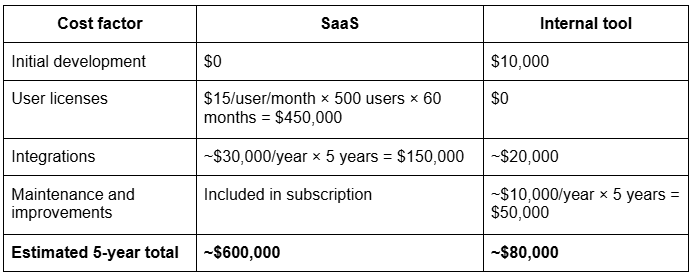
The typical explanation for SaaS versus internal ownership is that with the latter, you invest a lot upfront, and then there’s a point where it costs less than adding more SaaS tools and users. However, this assumes a blank slate — as if it’s a company created yesterday.
In reality, most have already grown a SaaS infrastructure of sorts, so they’re at a later stage. And the upfront investment in custom builds is now lower, too.
Hence a common “TCO crossover” at 60 months: for a 10,000-user organization, 5-year SaaS TCO can exceed $1.6M. Meanwhile, a custom platform can be built, hosted, and maintained for roughly $250,000. The numbers, of course, depend on details, but the principle works.
Financial Engineering: CapEx, Tax Credits, EBITDA
There’s another piece of this puzzle I feel is not discussed enough. Probably because accountants and CFOs don’t like writing articles like this.
It’s what the distinction becomes in purely financial definitions.
Because SaaS subscriptions are routinely treated as OpEx. Operating expense. On the income statement, the money’s gone every month. To buy useful stuff, yes. But gone it is, and it’s a perpetual drag on EBITDA.
With all the consequences in valuation, investor interest, etc.
However, custom software is different. Qualifying development costs may be capitalized as intangible assets, because, well, the company owns the thing. That’s CapEx – capital expenses. This kind of investment can be amortized gradually over several years.
Which means the EBITDA “fat” isn’t dispersed, and the company is a “fluffy kitty” enough to be considered cute by lenders, investors, and the like.
Not that everything should be built from scratch and turned into assets, of course.
And governments have noticed, too. In Canada, for example, the SR&ED program can refund a portion of eligible development costs for qualifying companies. Budget 2025 had the expenditure limit of $6M, allowing CCPS to claim up to $2.1 million in fully refundable cash investment tax credits annually. In practice, that translates to around 35% of the build.
The Proprietary Moat (M&A Valuation Premiums)
The funny thing about money is that the better you look at it from a long distance, the more likely it is to come close by. Countless businesses have gone down by obsessing over minor operational improvements while missing the big picture.
And the big picture in this century is technological defensibility — that is, how unique the operations are and what the company actually represents:
- A transient capacity repository with a name;
- A big holistic know-how that owns its aggregated practices and data.
In this respect, owning software capacities creates a kind of “IP moat” that commands greater valuation premiums in recapitalization or M&A situations.
The premium is not because “software is valuable” by itself. Rather, the proprietary architecture can create operational advantages and growth opportunities.
Suppose there’s a business generating $10M in annual revenue trades at 2.6x revenue, its implied enterprise value is $26M. At a 4.1x multiple — a premium associated with stronger technology characteristics — the same revenue stream implies a $41M valuation.
The difference is not the code itself; it is the buyer's perception of defensibility, scalability, and future growth potential.
During an acquisition, for example, the buyer is not only purchasing the current performance. They’re evaluating how much of that performance depends on factors outside of the company’s control. Now, supposing you’re the acquirer and see that
- Critical workflows are scattered across platforms;
- Databases follow some vendor-specific structures;
- Operational knowledge mostly exists inside GoWorkoQuicko™
- you will likely want to factor the additional transition risks into the valuation.
Figuring Out a Strategic Framework
Okay, so does all of that mean we should all quit SaaS for good?
Oh, come on.
Of course not. That guy from Minnesota who spent half a year and $1500 in 2015 to implement a sandwich taught everyone a lesson, didn’t he?
The question is not “own all capabilities” but rather “which capabilities are worth owning?”
There’s this postulate called the 70% Rule of Uniqueness:
If a standard SaaS tool solves >70% of your needs, buy it.
I’d paraphrase it a bit:
If it solves 70% of a process that does not differentiate your business, buy it.
You don’t have to reinvent stuff your company does in exactly the same ways as the others. But the remaining 30% of your workflows, that’s where ownership matters.
It can be some customer order optimization logic, or customer onboarding workflows. Some proprietary analytics Andy once famously spent two weeks developing while almost burning the office while smoking outside. Industry-specific automation that you would love to describe in detail in a blog post but won’t because it’s your competitive detail.
And curiously, what we at Danavero now spend quite a lot of time doing is helping figure out exactly that.
Not coding per se.
Defining what to include into custom software we build and what to relegate to other tools through APIs.
For the first time in our over 10 years of experience and 300+ completed projects, we are actually expected to bring this expertise in front of, well, coding.
We’ve been doing that all along but marketed it as a footnote. Now the times have changed. People are not coming to say “we want you to build us a robust tool because we like your 4.9 Clutch rating”. They say “you’ve seen projects like that, let’s figure out how to define the platform we want”.
An audit has become the main entry point. The part where we just look at where SaaS subscriptions have multiplied past their limits, where integrations are too fragile, and where critical business logic needs recovering into the company’s hands.
We now pair with with a 5-year TCO analysis to create a practical roadmap:
- What should stay rented?
- What should be consolidated?
- And what is important enough to build and own?
While the coding itself is taken for granted. By the client, not us, of course.
(Okay, now I’ll allow myself a real CTA. You can actually contact our team for an audit here).
Originally published on LinkedIn as an article.


