
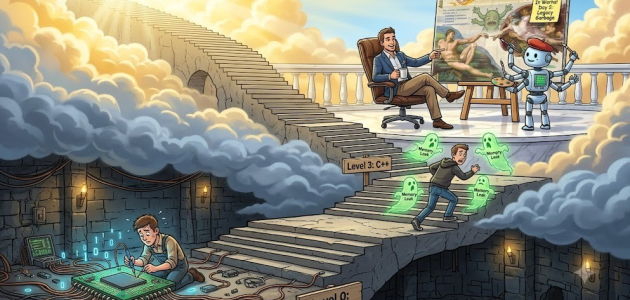
AI did not end software development. It moved us another floor up the abstraction ladder. Like Michelangelo's apprentices, AI does the grunt work, but someone must hold the vision.
I have a confession: I haven't written a single line of actual code in over a month. As someone running a business who still insists on keeping a hand on the technical wheel, this was a revelation. Plain English suddenly became a surprisingly damn functional programming language.
First, a quick pet peeve: please never call us "coders." God, I've always loathed that term. Typing syntax is just high-speed data entry with more semicolons. True Software Development is an art form and a strategic discipline - or at least, that's what I tell myself to sleep at night. A well-architected system is a masterwork, and a proper developer (much like a founder) is an artist holding a grand vision. Or an ego. Probably both.
I was probably busy hunting down a memory leak when the industry mysteriously divided itself into rigid "frontend" and "backend" camps. Apparently, understanding a system top-to-bottom went out of style while I wasn't looking. Call me an old-school dinosaur, but I still stubbornly believe if you don't know how the whole engine works, you shouldn't be poking around under the hood.
So when this AI shift exploded, I didn't see an impending apocalypse for software developers. We aren't getting thrown off the cliff - we're just getting hauled up to another floor on the abstraction ladder I've been laboriously dragging myself up my entire career.
To understand why this isn't the end of our profession, you just have to look at how ridiculous the ladder was in the first place. Here is a quick tour of my personal ascent through the tech ages:
Level 0: The Hardware Dungeon (Binary)
Back in the day, I was crawling through microcontrollers in raw binary. Level zero meant thinking in actual physical electricity: +5V meant a logical 1, 0 meant ground. Fetching a single damn byte felt like playing the piano by manually soldering live wires directly to the speakers.
Level 1: Assembly (Not Painful - Just Weird)
Then I stumbled into Assembly. It wasn't painful - it was just a completely different flavor of madness. I stopped worrying about which physical chip pin was getting zapped and started lugging data between registers and ports. It was like going from moving individual electrons to pushing heavy boxes around a digital warehouse.
Level 2: C & Pascal (Variables Exist!)
Goodbye registers, hello variables! Suddenly we had actual logic flows instead of endless jump instructions. But you still had to drag your own memory around like a ball and chain. Forget to clean up a memory pointer, and your program would quietly chew through the machine's brain until the whole damn thing crashed.
Level 3: C++ & OOP (Classes and Chaos)
Object-Oriented Programming brought classes, inheritance, and neat blueprints. I loved this era - hunting down memory leaks was my personal video game. I even wrote my own memory-tracking tools for fun (admittedly, a deeply weird flex).
Level 4: Java & .NET (The Maid Arrives)
Managed code stripped away my favorite toy: manual memory management. Suddenly, a background "Garbage Collector" was sweeping up after us. It felt like hiring a hotel maid to pick up your dirty socks, leaving us to focus on dragging ourselves higher up the architectural food chain.
Level 4.5: The Forgotten Sector (JavaScript...)
I probably missed a few things in between here. Like JavaScript escaping the browser to run everywhere, mutating from a silly little script meant to make web buttons wiggle into... well, I don't even want to talk about it. Let me keep my dignity as a business owner and pretend that whole circus didn't happen.
Level 5: AI & Natural Language (The Hyperactive Apprentice)
Now, we direct AI agents in plain English.
Look, I am obviously no Michelangelo - my personal artistic capability stops somewhere around drawing a lopsided stick figure. But think of the Sistine Chapel: Michelangelo didn't grind every ounce of pigment, slap down every square foot of raw wet plaster, or trace every outline onto the ceiling himself. He had a whole team of apprentices doing 90% of the grueling manual grunt work. But Michelangelo was still THE ARTIST. He held the grand vision, the composition, the anatomical mastery, and the soul of the masterpiece.
AI is just our hyperactive new digital apprentice. But if you don't actually know what the hell you're building, your apprentice will enthusiastically paint a six-fingered monster on the ceiling and call it a day. In fact, thanks to AI, the journey from "Look, it works!" to "Who built this unmaintainable legacy garbage?!" can now be completed in a record-breaking two days.
The Bottom Line
The tools change, but the core rule stays the same: you still need to be the artist who actually understands what is being built. Operating higher up the ladder doesn't eliminate mistakes - it just lets an untrained hand create giant messes at warp speed.
So no, software developers aren't going extinct. We're just handing off the paintbrushes so we can focus on the masterpiece.
Originally published on LinkedIn as an article.


