

I looked up at some dates from about 140 years ago (stay with me here).
So, 1882. Edison launches the Pearl Street Station in New York, the first power plant. The electricity era starts. Everyone excited.
Then 1883. A socialite / early influencer called Alice Claypoole Vanderbilt shows up at a fancy party in a dress with a light bulb in it. The bulb is powered by like 3-4 kg of batteries hidden somewhere under the skirt. Glamour!
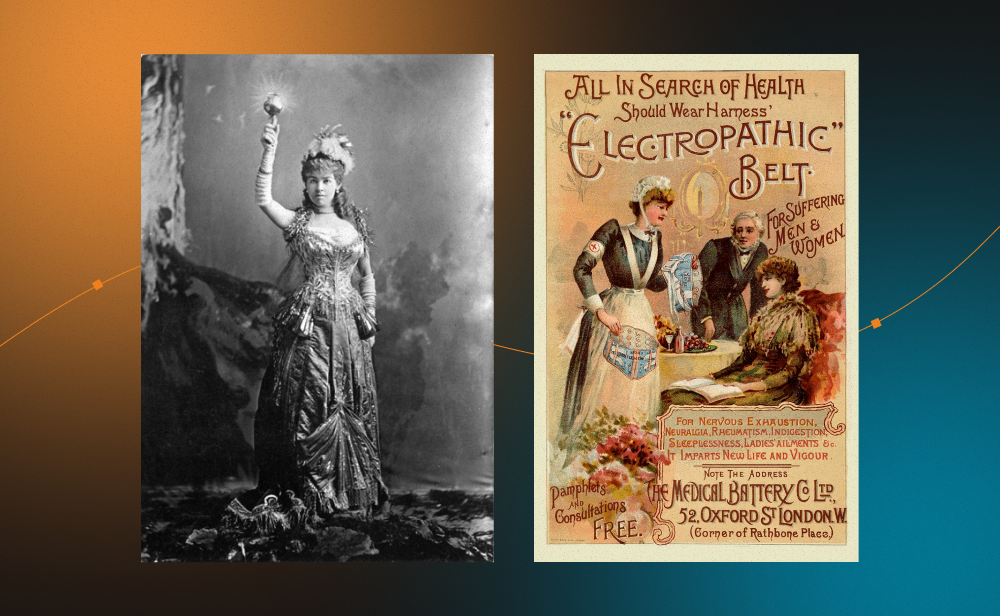
And then things get messed up. By the end of that same year, literally everything starts being “electric”. Even things where electricity has absolutely no business being. Marketing goes wild. They had “electric” corsets and belts that supposedly had medical effects.
Of course, they didn’t.
The corsets got shut down in 1893 because, hey, it’s an obvious scam. Many other similar products get shut down, too. But electricity itself obviously stays, just not the hype around it.
If you map this to AI, we are basically at the end of the hype explosion phase.
We already see cases where people “successfully” messed it up. And cases where it really worked well.
Characteristically, the failures seem more common.
There’s even a term for it: “pilot purgatory”. Around 70-90% of AI projects never leave the pilot stage. Not because “AI doesn’t work”. In the same way, people could have said “electricity is nonsense” back then.
People rush to adopt AI like: “everyone and their mom is doing AI, I must, too”. And then it’s like shocking yourself with electricity and hoping it fixes your back pain.
The Golden Rule of Automation
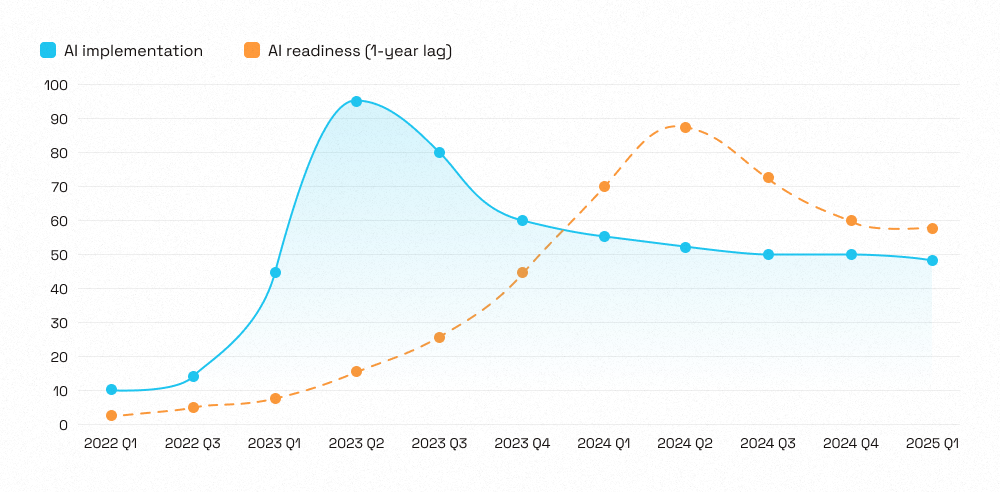
If you check Google Trends for “AI implementation”, everything is predictable: there’s a spike around 2023. Everyone suddenly wants AI. Fast.
But if you search for “AI readiness”, there’s also a spike. A year after that.
Translation: people tried stuff, had fun with AI for a year, failed, burned money, got yelled at by management, and then realized that maybe they need a strategy.
That’s where consulting exploded - Deloitte, Accenture, all others started pushing “AI readiness” as a concept.
And it shifted meaning, too. It’s not just about whether or not everything is digitized. It’s about whether your business is even structured enough to use AI properly.
Because if your operations are throat-deep in trouble, AI won’t automatically fix them. It may even cheerily say: “oh yes - your processes are in the gutter! Do you want me to push them even further?”
Or as Bill Gates basically said: if you automate a broken process, you just get a very efficient broken process.
I’ve seen cases like that.
A typical one, for example: a company with a terrible ERP system:
- People just hate using it. They do workarounds, copy data manually, and duplicate everything;
- Errors everywhere;
- Chaos in data;
- People working “around” the system instead of in it;
- Then someone says: “Let’s put AI on top of this!”;
- Everything goes even more sideways.
It’s like a Victorian lady saying: “Yeah, the battery weighs 4 kg, but whatever, my dress already weighs 10 kg, at least people will look at me.”
Hence all the pilots that everyone likes talking about until no one wants to scale them for real. Because pilots and PoCs live in a clean, beautiful world full of fairies and unicorns. While we all understand what kind of environment is one where people get their hands dirty and actually do something. If we want AI to work like we do we need to design these projects for the real world.
Danavero’s Proven Playbook (Where AI Actually Delivers More Value)
Okay, now some examples from our experience at Danavero. We’ve been trying out a lot, so here’s what actually worked well.
Case 1: The Ultimate Tier-1 Support Helper (Not Replacement)
This one’s a customer support optimization project. The typical variant of implementation would, of course, be to create a chatbot and let it handle requests. Something went wrong? Okay, then the client gets to talk to a human.
We went the other way. In our approach, the AI shovels through heaps of information on the backend, completely unseen by the customer. A request comes in - the AI intercepts it, digs through the database, looks up interaction history, and drafts the reply.
The reply is sent to the human operator who checks it, formats it, and then sends it to the customer. Essentially, the AI acts as an assistant.
The result? Our measurements showed a 2-5x performance increase per support specialist. In the meantime, 0 (zero) clients got mad at the chatbot because they hadn’t been talking to a chatbot in the first place.
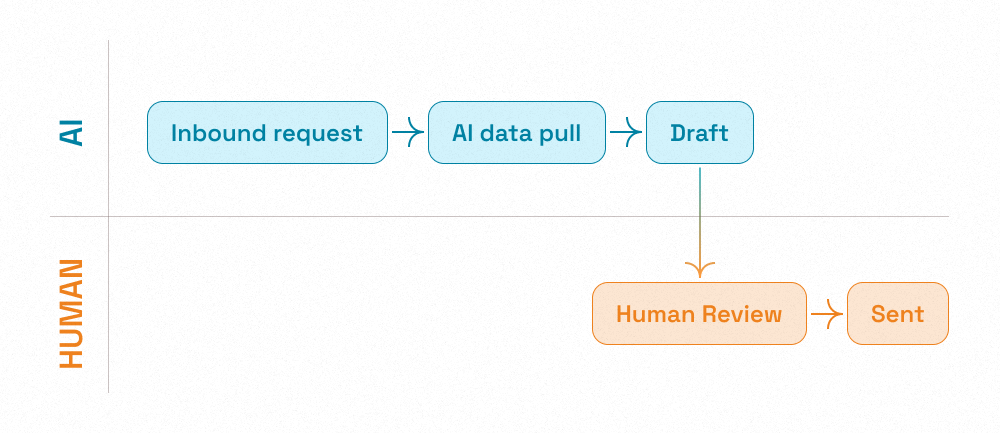
In reality, what did we do? We looked at what phases in the process are used to eat up time in real environments. And it was not written back to the customer. In reality, the support manager only spends about 15% of their time replying. Meanwhile, about 60% of the time is comprised of fiddling with filters and search fields:
- Understanding what’s required;
- Entering data manually;
- Searching the database;
- Looking up stuff in the knowledge base;
- Checking the interaction history.
That’s where the time drained. We totally could have made the AI just compose beautiful replies. Heck, we could make it reply in verse. Only what sense would it make? Speed up some ⅙ of the process, and only in the more obvious cases?
It just made more sense to have the AI look up data - the AI doesn’t even have to type stuff in those milliseconds it takes. Automating those micro-actions was the most sensible option.
Case 2: Instant First-Touch Lead Response
Another case is with sales. That’s where things get different. The first instinct (and the incorrect one) is to feed AI with best practices from “good” sales call scripts and just hope it will lead the prospect toward conversion.
And then freak out if (or when) something gets messed up.
So we thought: where is the point in the process where superhuman speed would make a difference? Where would you need the “whooooooosh - done”? In reality, it’s the first minutes, or even seconds, after the customer’s initial query. That moment where the person has written something, they are somewhat interested - but in a minute or so, they’ll likely either forget it or change their mind. Salespeople know this moment: when you need to grab and hold the lead.
What does the AI do in this process? It snatches the customer query, grabs the context, and “shoots” a reply to the prospect straight away. An accurate, personalized, relevant reply. No one can be sure the AI would keep that quality consistent throughout the conversation - but no one really needs that.
Because the AI’s task here is not to close the deal, but rather to give a good first reply at once, and thus win time and keep the prospect there while the salesperson is getting ready to take over.
Theoretically, one could try to make AI do everything here. But the more phases AI’s activity covers, the more mistakes it can make along the way. Mistakes that will then need to be analyzed by someone. Since we want quick outcomes, we identify the task that gives the maximum bang for the buck. In the meantime, if something goes wrong, you can always pinpoint where exactly.
The “Secret Sauce” — Human-in-the-Loop (HITL)
What both cases have in common: AI does not do everything. Humans do not do everything. Each does what they’re good at.
That’s a variation on Human-in-the-Loop (HITL). To clarify a common misunderstanding: we don’t treat HITL as “AI does everything and human fixes mistakes” - that’s more like “human-ON-the-loop”.
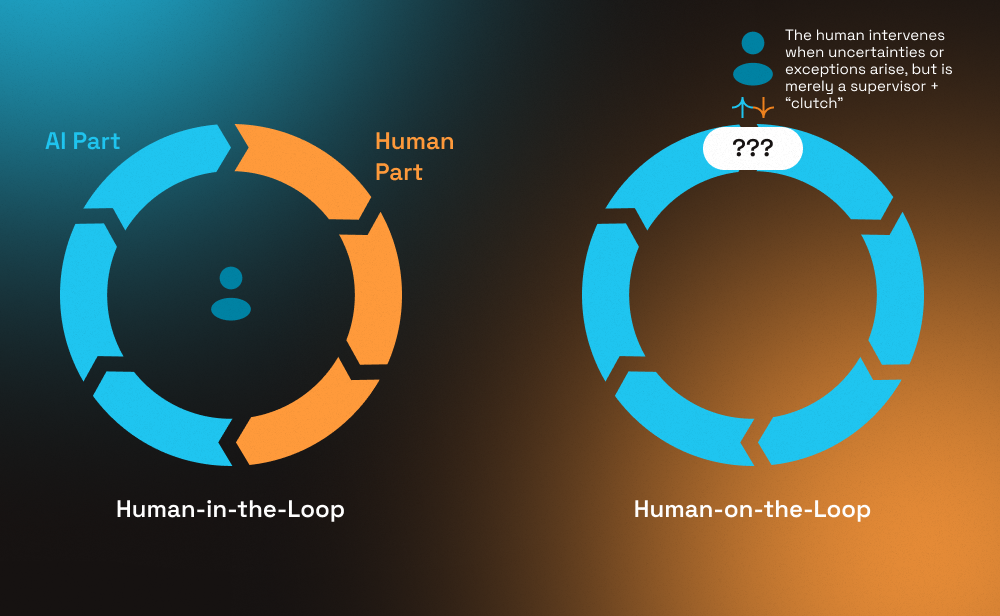
Real HITL is when both actively contribute to the process.
Not because AI is “incompetent”. Not because the human acts as a “clutch”. We just look at where AI would potentially bring more value and use it there.
Final Thoughts
Of course, a lot of companies want to just put AI to work and go fishing/playing tennis/whatever. But that doesn’t mean that’s what actually brings ROI. I’ve looked at case studies after case studies, and the recurring pattern is the same. Success is when people look at their processes closely enough before doing AI.
So, “shall I implement AI?” Yes. Just make up your mind on what it is that AI should be doing for you. AI is not a human substitute; it’s more like a superpower that you need to know where to use.
I’m pretty sure if you’ve read until this point, you must have had something of an AI journey, too. What has it looked like, then?