Canada, AI Machine Learning, Enterprise, Information Technology & Services, Financial services

CEAI: the centre of the business, or why your next ERP may not be an ERP at all

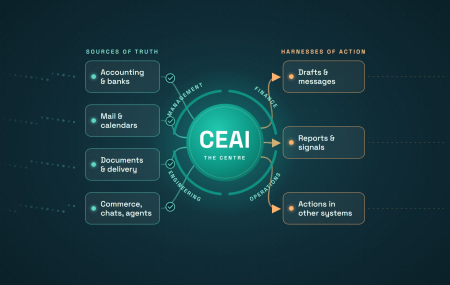
Diagram of CEAI, the Chief Executive AI: sources of truth on the left pass validation checks into the centre, which is surrounded by the compartments management, finance, engineering and operations; harnesses of action are on the right.

About the Project

1
Customer:

What is a Chief Executive AI?

First of all, it is the centre of a business. Not a chatbot on the side. Not one more tool in the stack. It is the piece that connects the company's sources of truth with the decisions that rest on them, and those decisions with the actions that follow.

A source of truth is not a data set. A mailbox is a data set: newsletters, notifications, guesses, drafts and, somewhere in between, the facts. A source of truth is what remains after validation: e-mails that are relevant to the business and confirmed by a higher source when they carry a figure, bank lines that reconcile to the statement, invoices that match the books. Only that is fed to the AI to make a decision.

Around this centre sit two kinds of systems. Sources of truth feed it. Harnesses of action let it act. Everything else is plumbing.

Who it is for

CEAI is for companies that have outgrown the idea of one more tool: several legal entities, several banks and currencies, an accounting platform, a CRM or an ERP, a project tracker, years of e-mail and documents spread across shared drives. CEAI is Danavero's own product. Today it is the centre of three companies:

  • a software development company working in AI and custom software;
  • an e-commerce group with legal entities in several countries, selling through its own online store and marketplaces;
  • a technology company.

Each one has its own CEAI: its own sources of truth, its own rules, its own compartments and its own cloud.

2
Project overview:

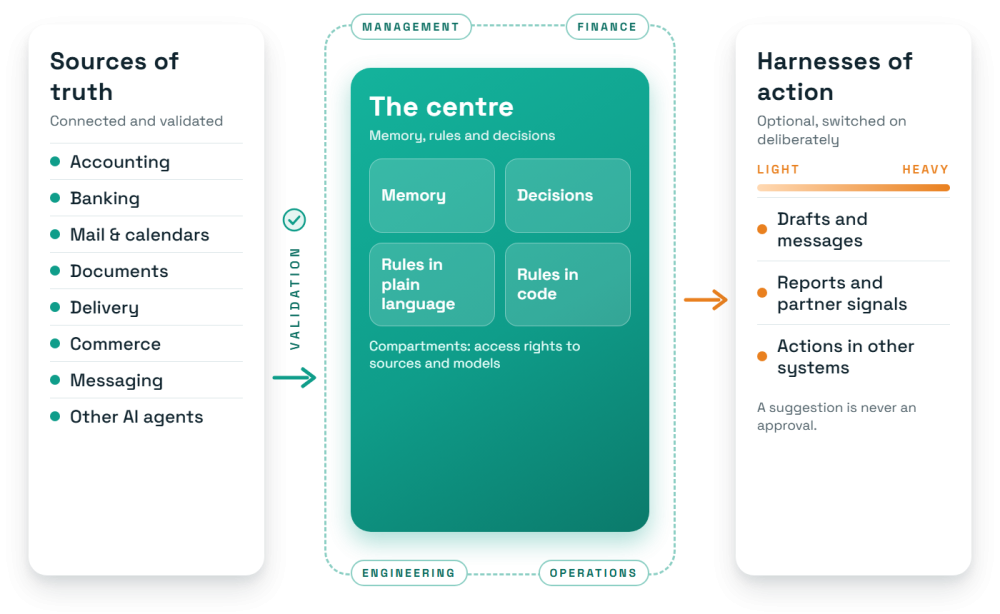
CEAI has four parts: sources of truth, the centre, harnesses of action and compartments.

The four parts of CEAI: sources of truth such as accounting, banking, mail, documents, delivery, commerce, messaging and other AI agents pass validation into the centre with its memory, decisions and rules in plain language and in code; compartment walls surround the centre; harnesses of action go from drafts and messages to actions in other systems.

The four parts of CEAI.

Sources of truth

CEAI connects to the systems the company already runs. Examples connected so far:

  • Accounting: QuickBooks Online, Sage Intacct.
  • Banking: statements from every bank and payment account, for example Wise and PayPal.
  • Mail and calendars: Gmail, Microsoft 365 Outlook, Google Calendar.
  • Documents: Google Drive shared drives.
  • Delivery: Jira, GitLab.
  • Commerce: Shopify.
  • Messaging: WhatsApp chats.
  • Other AI agents: a tender-discovery agent, an accounting agent.

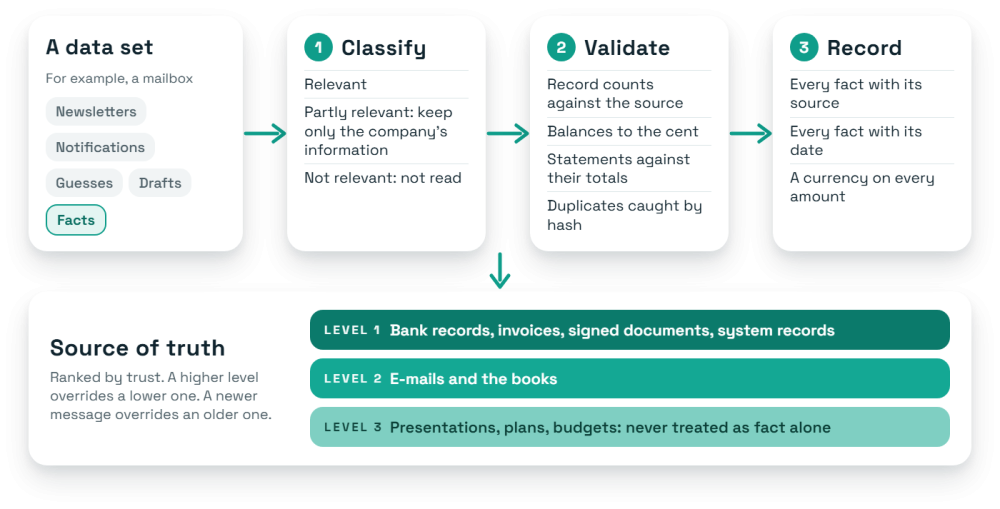
A connected system does not become a source of truth by itself. CEAI makes it one:

  • The owner classifies every mailbox, drive and chat as relevant, partially relevant or not relevant. Nothing else is read. From a partially relevant source, only the company's own information is kept.
  • Every load is validated: record counts against the source, balances to the cent, every bank statement against its own printed totals. Duplicate files are caught by their cryptographic hash.
  • Every fact is written down with its source and date.
  • Sources are ranked by trust: bank records, invoices, signed documents and system records first; e-mails and the books second; presentations, plans and budgets last. A higher level overrides a lower one, a newer message overrides an older one, and a figure found only in a presentation is never treated as fact.
How a data set becomes a source of truth: classify it, validate every load and record every fact with its source and date; then rank the sources by trust, from bank records and invoices, to e-mails and the books, to presentations and plans.

From a data set to a source of truth.

The centre

The centre holds the company's memory and its rules, and it makes the decisions. The memory is structured knowledge in the company's private repository, with full version history: customers, contracts, suppliers, people, projects and money. The rules come in two languages:

  • Rules in plain language, where judgment is needed. For example: what counts as a payable invoice and what is only a quote; which bill is critical and which can wait; what to do when two sources disagree.
  • Rules in code, where the answer must be the same every time. For example: loading and reconciling bank statements, copying the books, rendering the management reports, checking that every amount carries its currency.

The AI decides where a decision needs judgment. Scripts act where it needs determinism. When a value is missing from every source, the centre does not guess. It asks a person.

Harnesses of action

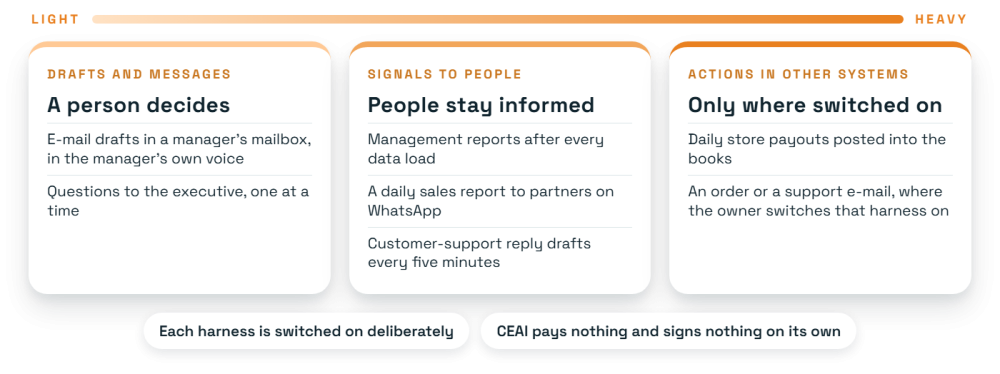
Harnesses are optional. Each one is switched on deliberately, and each one has its limits:

  • At the light end, drafts and messages: e-mail drafts in a manager's mailbox, written in that manager's own voice; questions to the executive, one at a time.
  • Then signals to people: management reports regenerated after every data load; answers and a daily sales report to partners on WhatsApp; reply drafts to customer-support mail, every five minutes.
  • At the heavy end, actions in other systems: the daily store payouts posted into the books today; placing an order or sending a support e-mail where the owner switches that harness on.
Harnesses of action from light to heavy: drafts and messages, signals to people, and actions in other systems, each switched on deliberately; CEAI pays nothing and signs nothing on its own.

Harnesses of action, from light to heavy.

A suggestion is never an approval. CEAI pays nothing and signs nothing on its own.

Compartments

Not everyone who works with the executive agent should see every fact. So the data is split into compartments, and the compartments are not managed by the AI. They are managed by access rights to the sources of truth and to the models: who may read which repository, which drive, which data set, which mailbox. At one company, the knowledge sits in tiered shared drives and repository groups – management, finance, engineering, operations, media and company – each with its own members. HR personal data is kept out entirely, and outputs that name individuals with amounts are aggregated. Every service account writes only to its own data set, and the keys to accounting and project systems are read-only. And every company's CEAI is a compartment of its own: its own repository, its own cloud, its own rules.
3
Challenge:

The old centre

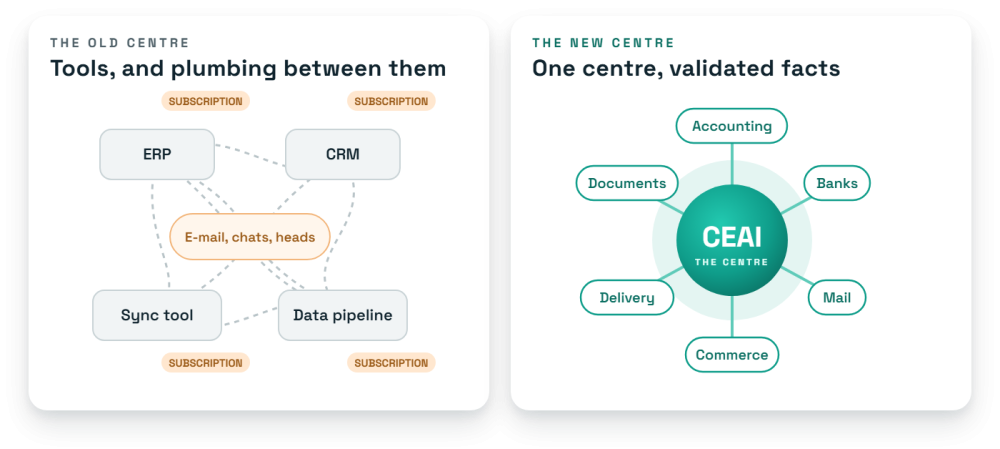
Ask what an ERP is, at the end of the day. It is a database with rules written on top of it. A CRM is the same, with customers in the middle. Companies pay a subscription for each, then pay people to move data between them, then buy one more tool to keep the two in sync. And the real truth still lives elsewhere: half in the systems, half in e-mail, chats and people's heads.

Bolting an AI onto that picture changes little. Around 1900, factory owners replaced the steam engine with an electric motor and waited for the miracle. For about twenty years almost nothing changed. The motors were new. The thinking was old.

The old centre: an ERP, a CRM, a sync tool and a data pipeline, each with its own subscription and tangled connections. The new centre: CEAI connected to accounting, banks, mail, commerce, delivery and documents.

The old centre and the new one.

Data sets are not truth

Feed an AI raw data sets, and it will guess. Early in one deployment, an executive review found that about 30% of a list of charges rested on assumptions. The answer was not a better prompt. It was validation before decision: no assumptions, a source and date for every fact, trust levels for every conflict, and a currency on every amount.

One centre, many people

A centre that knows everything is only safe if it does not show everything to everyone. Compartments had to be built into the access rights from day one, not promised by the AI.

The edges resist

Old systems were built to be the centre themselves. One accounting vendor quoted two annual licences just to let any tool read the data through its API. Permissions, vendor roles and licences are often the slowest part of the work. The AI is not.

4
Results:

The centre came online in days

The core set-up took two days at the software company and about five days at the e-commerce group.

Sources of truth at scale

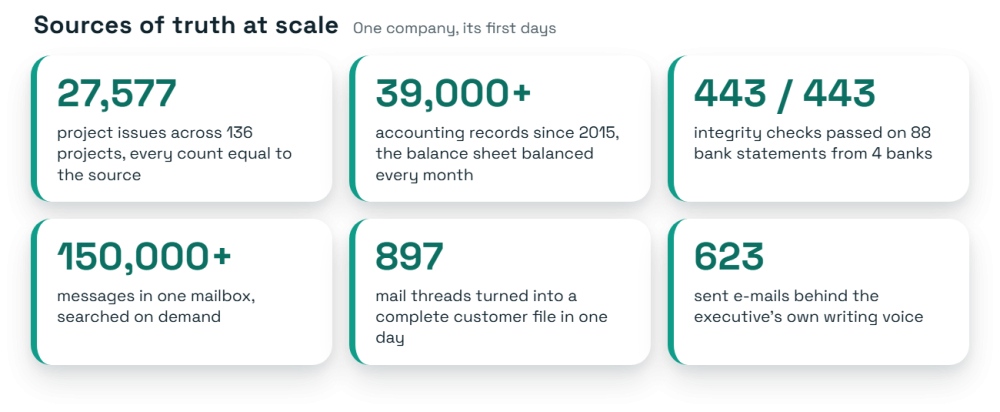
At one company, in its first days, CEAI validated and took in:

  • 27,577 project issues across 136 projects and six years of delivery history, with every count equal to the source;
  • more than 39,000 accounting records covering the books since 2015, with the balance sheet balanced in every month, and 2,349 source documents;
  • 88 bank statements from 4 banks in 3 currencies, with 443 of 443 integrity checks passed;
  • a mailbox of more than 150,000 messages, searched on demand at any age, with only the relevant facts kept;
  • a complete customer file, contracts to payments, built from 897 mail threads in one day;
  • the executive's own writing voice, modelled on 623 sent e-mails.
Sources of truth at scale at one company in its first days: 27,577 project issues, more than 39,000 accounting records, 443 of 443 checks on 88 bank statements, more than 150,000 messages, 897 mail threads and 623 sent e-mails.

Sources of truth at scale at one company, in its first days.

Decisions on validated facts

The executives ask the centre, not the systems: "What's new? My tasks for today?" "What is due to this supplier?" "Why is my loan in the books different?" "Check the last messages from my partner. What budget changes is he asking for?" "What do we really need at minimum?"

Harnesses at work

Partners get a daily sales report on WhatsApp and ask the business questions there. Customer-support drafts are ready every five minutes. Store payouts are posted into the books every day. E-mail drafts wait in the manager's mailbox; a person presses Send.

Subscriptions switched off

At the e-commerce group, CEAI replaced two paid tools, an accounting sync and a data pipeline, with its own rules and scheduled pipelines. A parallel run showed one differing order before the old pipeline was turned off. At the technology company, CEAI found a vendor-native reporting route that needs no API licence, and the two annual licences were not bought. That is not an efficiency gain. It is a cost line that disappears.

The next subscription to go

The same logic scales up. An ERP or a CRM is a database with rules. CEAI can read those tables directly, take over the rules – in plain language where judgment is needed, in code where every run must give the same answer – and act on them through its harnesses. At that point the ERP or CRM subscription is no longer needed. The savings are not only hours. They are the subscription itself.

The centre checks itself

Duplicate bank files were caught by their hash and booked only once. After an outage, a self-audit counted 15 failed runs and confirmed that the next runs caught up with no data lost.

Our Team on this Case

A team of 2 to 5 specialists builds CEAI, with AI agents as tools. Two months in, and the work goes on. We build the centre first: we connect your sources of truth, set up the compartments, write the rules in plain language and in code, and switch on the harnesses of action you need. Then we look at which subscriptions you still need. Tell us how your company works today, and contact Danavero to see what it looks like with AI at the centre.
Product Team:
Project manager
Development Team:
Tech Lead
Solution Architect
DevOps Engineer
AI Developer

Our Development Process

Working in Agile Scrum allows greater flexibility, agility, and the opportunity to adjust requirements, shift directions, replace features, and involve users to deliver the very product they need.
1
Image
Schedule a call
Call
2
Image
Business Analysis
Business Analysis
3
Image
Bulk Estimation
Bulk Estimation
4
Image
Negotiation
Negotiation
5
Image
Development
Detailed Estimation
6
Image
Estimation
Project Development
7
Image
Negotiation
Result
Call
First, we have an intro call and discuss your vision, goals and specific needs. This helps us understand your project’s scope and how our technology solutions could best support your business.
Business Analysis
In the next step, our team conducts a careful business analysis to dive deeper into your project’s requirements. We evaluate your targets and potential challenges to ensure our solutions are perfectly aligned with your strategy and deliver maximum value.
Bulk Estimation
Based on the initial call and business analysis, we provide a bulk estimation. This preliminary budget gives you a broad understanding of the project's financial effort, helping you plan resources and prioritize features effectively.
Negotiation
Once an estimate is provided, we give you time to review and get back to the discussion to refine the project scope, timelines, and costs. Our goal is to reach a mutual agreement that balances your budget constraints with the desired project outcomes, ensuring a win-win situation for both parties.
Detailed Estimation
After we have final requirements settled, we prepare a detailed estimation. This comprehensive breakdown includes specific costs, timelines, and deliverables for each phase of the project, providing transparency and setting clear expectations.
Project Development
Here’s the time to bring your ideas to life! We focus on the prioritized features, take care of the technical implementation and quality assurance, at the same time allowing you to monitor the process and make informed decisions throughout all the development stages.
Result
We’ve got it! A dynamic, user-centered, enhanced product is ready to boost your business. And your vision is transformed into a scalable solution tailored to your needs.

Other Case Studies

All Case Studies
text2hit
Text2Hit: AI songs from a few words, or how I got tired of writing lyrics
Custom Software Development
AI Machine Learning, Media
AI, LLM, NLP
obama care
EngagePoint Architect Suite for Obamacare
Custom Software Development
Government, HealthCare
Java, Ember.js, Oracle, IBM Db2
Screenshot of the Wingspan website
Clinical Trial Management Software for Wingspan
Custom Software Development
Enterprise, HealthCare
Java, Spring, Scala, PostgreSQL, React
Screenshot of the IQVIA website
ePromo Cloud-Based CMS for IQVIA
Custom Software Development
Enterprise, HealthCare
Java, Spring, Scala, PostgreSQL, React
Screenshot of the Vision Technologies website
Web Development for Vision Technologies
Web Development, UI/UX Design
Information Technology & Services
Drupal
Screenshot of The Economic Club of Washington, D.C. website
The Economic Club of WASHINGTON D.C.
Web Development, UI/UX Design
Non-Profit Organizations
Drupal, PHP, Salesforce
Screenshot of the Surex website
Surex
Web Development, UI/UX Design, SEO
Insurance, Financial services
Drupal, PHP
Screenshot of the Aeopsi website
Aeopsi (MVP for startup)
Web Development, UI/UX Design
FinTech
Drupal, Java, Stellar Blockchain
Screenshot of the Amtrak website
Amtrak
Web Development, UI/UX Design
Transport & Logistics
Drupal, PHP
cook report
The Cook Political Report
Web Development
Media, Non-Profit Organizations
Drupal, PHP

Start a project with danavero

Fill in the form, and we will be in touch shortly.
CAPTCHA
Your Privacy is protected
2021 Top Software Testing Companies Award Badge
Top Digital Marketing Company Award Badge
Badge for visiting Danavero profile on AppFutura listing
2023 Top Software Developers Award Badge
2020 Top Web Development Companies Award Badge
2023 Top Web Developers Award Badge
Badge for visiting Danavero profile on Clutch listing
2021 Top App Development Companies Award Badge